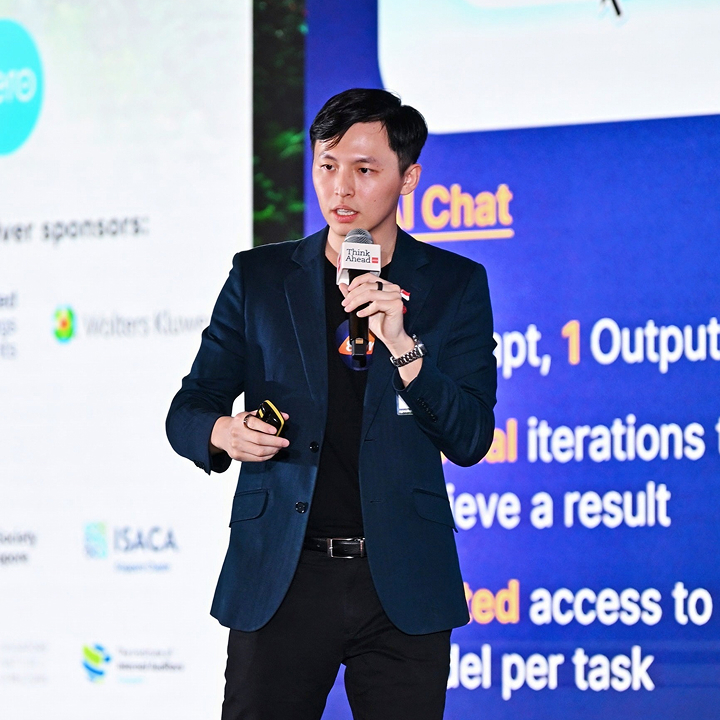
 By Joshua Chang · 8am Business
Just another day at work. HR just bought you a Gallup code to access your CliftonStrengths report, and IT has a mandate on maximising token consumption to "improve organisational productivity". Right now, these two things have nothing to do with each other.
What if it was?
What Combining CliftonStrengths with AI Coaching Actually Means
Using Cliftonstrengths with AI coaching means holding two of your greatest tools in the Age of AI: a clear map of your natural strengths from the Gallup assessment, and a structured AI practice that routes your daily decisions and prompts through those strengths. The value is not that AI replaces a coach. It is that your strengths profile can bring you something actionable immediately, and it's unique to you.
The same qualities that make someone a great leader still determine whether AI augments or overwhelms their decision-making. A strengths profile without an AI practice stays theoretical. An AI practice without a strengths profile stays generic and aimless.
Why Your Dominant Strength Changes How You Should Prompt AI
Take a leader with Activator as a dominant CliftonStrengths theme. Activator is the drive to turn thinking into action immediately. When an Activator leader asks AI to help evaluate a new market entry, their instinct is to move to a recommendation fast. Left unchecked, they will accept the first confident-sounding output the tool produces and brief their team on it.
A structured strengths-aware AI practice puts a pause on this blind spot.
Instead of prompting the AI with "What should we do about entering the Vietnam market?", an Activator leader coached to work with their strength would prompt:
"Give me three decision triggers that would tell me this Vietnam entry is ready to move on, and three signals that would tell me to pause. Flag any assumptions you are making about our capacity."
This changes two things. It satisfies the Activator's drive for forward motion, because the output is action-oriented and decision-ready. And it forces a deliberate pause before execution, which is exactly where Activator leaders unaware of their blind spots are most exposed to risk.
The same market entry question asked by a leader with Analytical as their dominant theme would require a different prompt structure entirely. An Analytical leader needs depth and data lineage, not triggers. Their risk is the opposite: they will keep asking the AI follow-up questions and delay the decision indefinitely because no AI output will ever feel complete enough.
The prompt is not just a question. It is a mirror of your strength and, if you are not paying attention, a mirror of your blind spot. Knowing your CliftonStrengths theme tells you which mirror to watch.
What the Google AI Answer Gets Right, and What It Skips
Google's AI overview (October 2026) notes that Gallup integrates AI-powered coaching and analysis directly into Gallup Access, and that individuals are already using large language models like ChatGPT or Claude as on-demand personal strengths coaches by sharing their top 5 or full 34-theme report.
That is a reasonable starting point. Pasting your top 5 into a chatbot and asking it to coach you will produce something useful at first.
But it is not the same as structured AI coaching for three reasons.
- First, the AI has no continuity. Unlike a coach, the new session doesn't prompt you follow up on the previous conversation. So actions are not followed through.
- Second, there is no accountability loop. If promised actions are not followed through, you risk disappointing a coach you are trying to build rapport with. It's hard to feel the pain of broken trust with a chat.
- Third, a trained coach interpreting the interaction between, say, Activator and Responsibility in a high-stakes people decision can draw on their own personal experience of coaching other leaders. These critical insights are more often than not private data - they are not accessible for the AI to train on or derive on their own to give as strategic insights in a coaching insights.
The Failure Mode: Strengths-Blind AI Adoption
A leader who delegates decisions to AI without a strengths lens risks letting the tool flatten the very judgment that made them effective in the first place.
The mechanism is straightforward. AI outputs are generic by design. They are optimised to be plausible and broadly applicable. A leader with high Analytical strength needs to probe those outputs with specific data challenges. A leader with high Empathy managing a restructuring decision needs to surface the human cost assumptions buried in any AI-generated recommendation.
Without the strengths filter, the AI becomes a confidence prop rather than a thinking partner. The leader stops asking the questions their strength would naturally generate. The output sounds authoritative. The decision gets made. And six months later, nobody can quite explain why ROI falls short on certain strategic decisions.
This is not a technology problem. It is a self-awareness problem that a Gallup StrengthsFinder assessment and a structured practice can solve.
Your Next Step: Take or Revisit Your CliftonStrengths Assessment
You cannot route AI interactions through a strengths advantage you are unaware of. That is the simple reason the assessment comes first.
If you took your CliftonStrengths assessment years ago and filed the report, revisit it before you try to apply it to AI-era decisions. The themes do not change, but your understanding of how they interact under pressure usually does.
If you have never taken the assessment, that is the one action we are asking you to take.
The 8am Gallup x AI Leadership programme is built around exactly this sequence: assessment first, structured AI coaching practice second. Give us a ping and start here.